scFoundry
Deploy, run and evaluate single-cell foundation models with one command
scFoundry runs more than a dozen single-cell foundation models (scFMs) alongside
established baselines through one containerised, reproducible interface — zero-shot
embedding, label transfer, fine-tuning, benchmarking and representation-geometry probes,
all from the same .h5ad input.
pip install scfoundry
scfoundry init my_project && cd my_project
scfoundry download --method scgpt
scfoundry embed --method scgpt --data demo/colon_1000.h5ad
Start here
Python, Nextflow and a container runtime — nothing else. No per-model environments.
The .h5ad contract: raw counts, full transcriptome, and the columns each task reads.
Embed, score and annotate the demo data end to end in about fifteen minutes.
Tasks
Turn a count matrix into a cell embedding — zero-shot with any scFM or the pretrained Census scVI, with PCA, or with a batch-integration method.
Score an embedding against known cell types and batches with the thirteen metrics of the paper.
Label new cells from a labelled reference on frozen embeddings — prototype, kNN, logistic regression or an MLP head. Nothing is trained in the model.
Update a model’s parameters on labelled cells following its authors’ recipe, then predict.
Effective dimension, anisotropy, expression-neighbourhood preservation, intrinsic dimension and variance decomposition of an embedding.
The benchmark design, the 26-tissue dataset, and how every metric and probe is defined.
Benchmark results
Across 26 tissues and 548,977 cells, only one of the thirteen foundation models is significantly better than a plain PCA reference, and eleven rank below it. Browse the rankings, or explore every method, tissue and metric interactively.
The same embeddings measured rather than ranked: which models collapse onto a few directions, and how closely each one preserves the expression neighbourhoods of its input.
Extending
Evaluate your own model’s embeddings under the paper’s protocol without writing any code, wrap a model as a method that every task can run, or contribute it back.
How a run looks
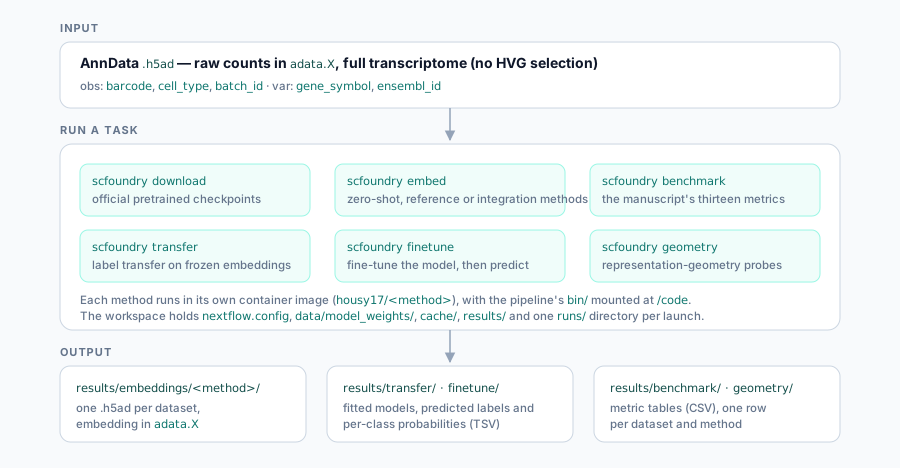
Every task takes the same input contract and writes to a predictable location under
results/. Selecting a method selects a container image and the method’s own recipe;
nothing else about the command changes.
Citing scFoundry
Please cite
Siyu Hou, Penghui Yang, Wenjing Ma, Jinxi Xiang, Jade Xiaoqing Wang, Hui Wan, Ying Ma and Xiang Zhou (2026). Accessible and reproducible deployment reveals the practical boundaries of single-cell foundation models. bioRxiv, https://doi.org/10.64898/2026.01.06.698060 (revised version to appear within one to two weeks).
Full BibTeX and the per-model upstream citations are on the citation page.